

Only just beginning
Reflections from a two-day workshop in Japan on teal organisations, adult-adult leadership, and an ancient word for nature

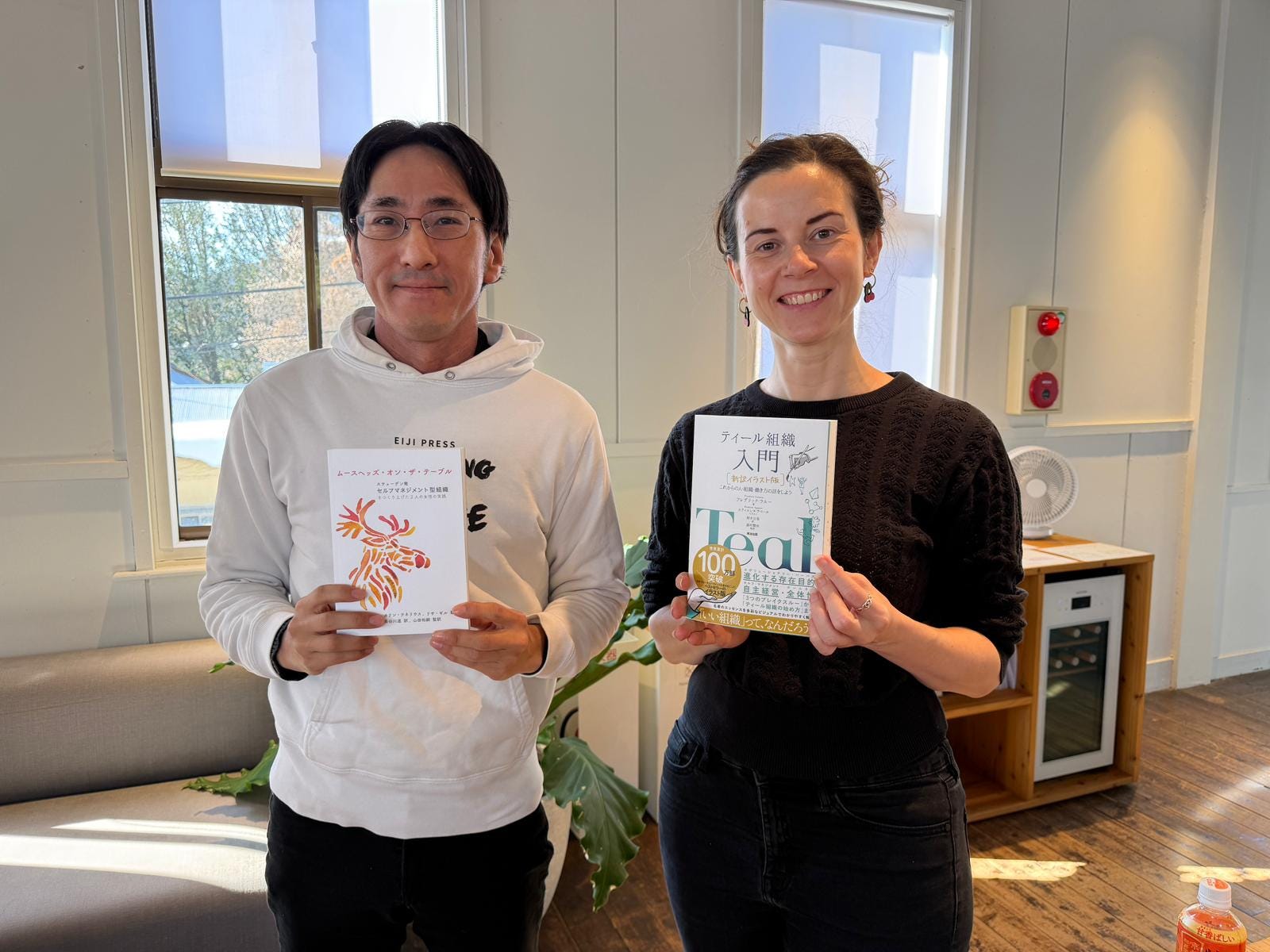
This month I am in Japan celebrating the launch of my book – Moose Heads on the Table: Stories About Self-Managing Organisations from Sweden co-authored with Karin Tenelius – in Japanese. As part of the launch, I have been facilitating a number of workshops. This series is about my reflections – what I am learning from Japanese participants and how my work with Tuff and adult-adult leadership is resonating here.
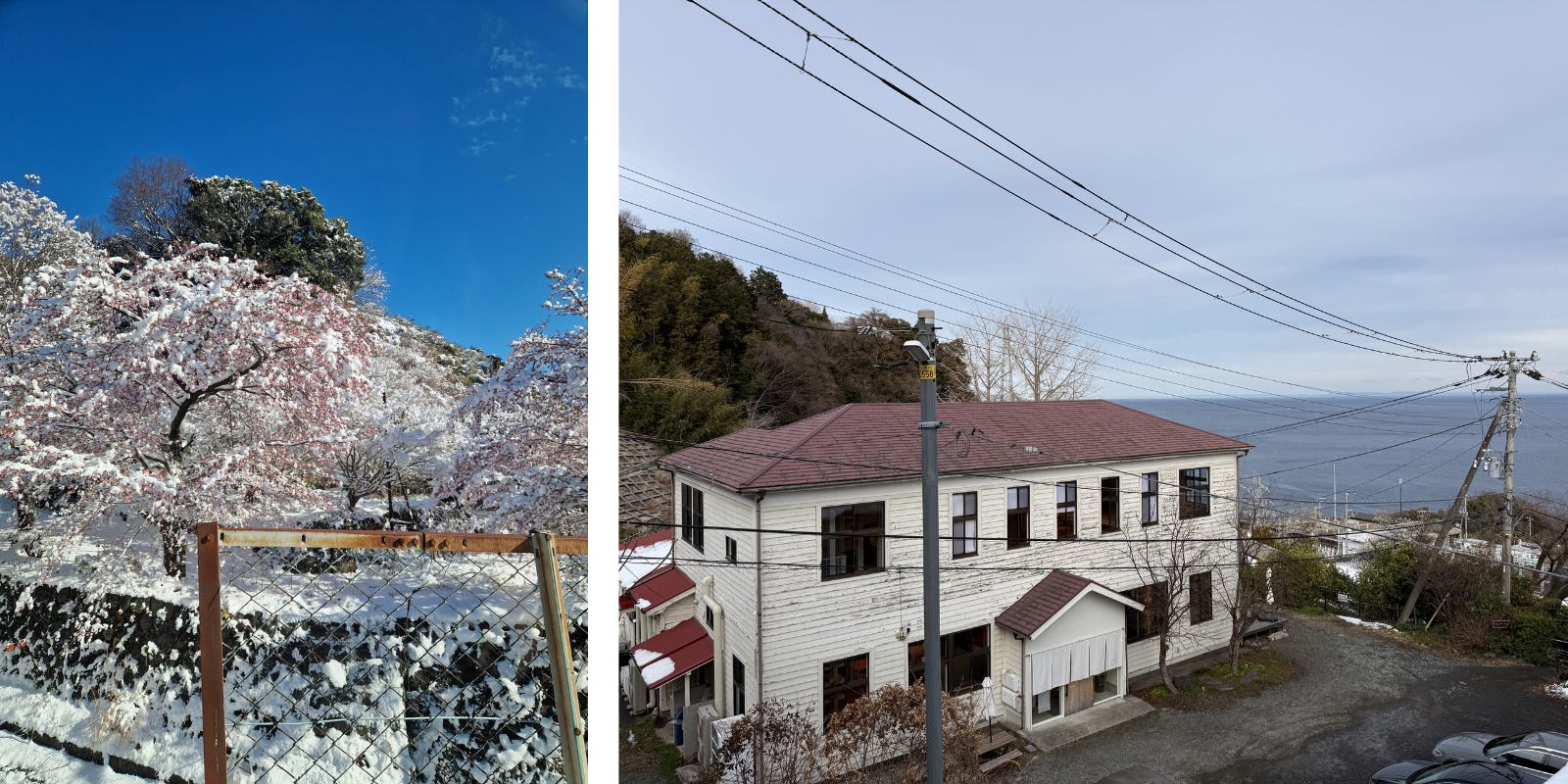
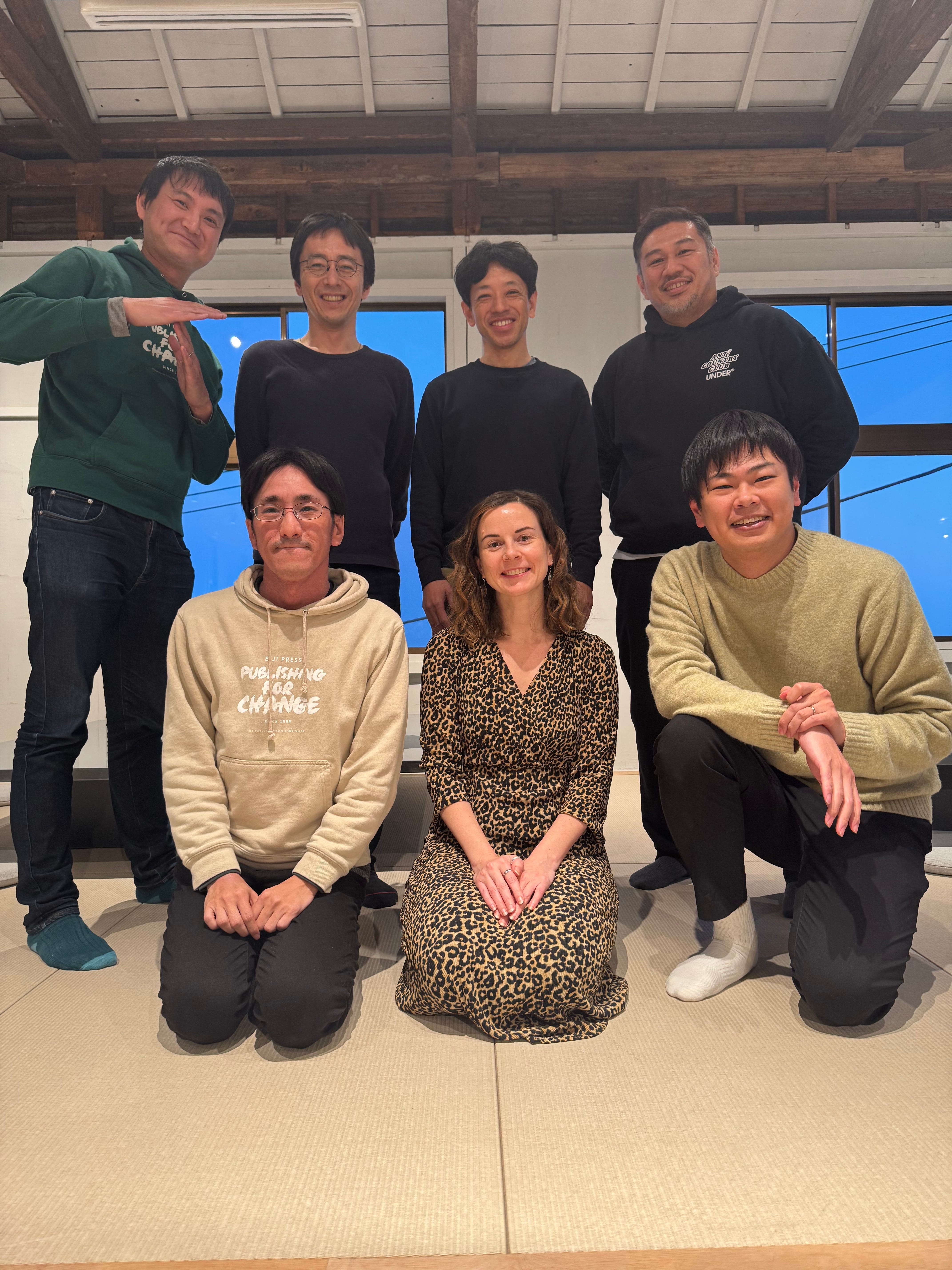
Part 1 is about a two-day workshop I co-facilitated with Kenshu Kamura, Hideaki Aono and Yuji Yamada in Odawara on the topic of teal and next stage organisations
“Did humanity somehow get the way we build organisations wrong?”
This is the question that Kenshu Kamura was asking himself ten years ago. With a background in community development, he had been using dialogue-based approaches in organisations to tap into the collective wisdom of groups. But the pattern he was noticing was exhausted change leaders, and teams overwhelmed by complexity, yet trapped in hierarchical structures. How, with all our technological advances, had organisational structures changed so little? He decided to take a year off work to explore these questions.
Around this time he discovered an article in English that introduced the concept of teal organisations. Kenshu writes: “What shook me most was the realisation that entirely new kinds of organisations—ones not simply extensions of the past—were already emerging around the world.”
In 2017 he attended the Next Stage World Conference in Rhodes, Greece and from the connections he formed there, he began inviting practitioners in methodologies – such as Holacracy – to Japan. He then learned that a translation project of the book Reinventing Organisations had begun at Eiji Press and joined the team. Published in 2018, the book’s ideas spread fast around the Japanese business world. Reading circles and study clubs sprung up all over the country. To date, it has sold more than 100,000 copies.
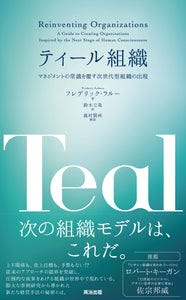
The rapid popularity of the book caught the attention of its author, Frederic Laloux. He reached out and Kenshu went to visit him in New York. After initially declining an invitation to visit Japan, Frederic accepted. They organised a Teal Journey Campus conference for 500 people and a two-day retreat for around 15 executives and next generation-leaders. It was a memorable week for all involved.
Kenshu says at the end of this experience “I made a quiet vow within myself: from now on, my role would be to help the ideas of teal organisations take root in Japan.” He has travelled to Europe to visit many of the case study organisations from the book, such as Buurtzorg in the Netherlands, studied different approaches, and collaborated with many practitioners.
“Through these journeys,” he says, “I became convinced that teal organisations are not a single replicable model. What is now emerging is an era of diverse organisations rooted in human stories.”
I first learned about Kenshu from Yuji Yamada, who I met through Tom Nixon on a Zoom session in 2021 entitled “Future-of-work in Japan.” Yuji told us about the budding teal and new ways of working in Japan, and how Japanese people had embraced the principles in their own way.
When I interviewed Yuji on my podcast in 2021, he talked about the concept of JINEN Management, a term he was experimenting with to try and capture the kind of leadership or collaboration that would suit a teal organisation in Japan.
The word jinen means nature in Japanese, but in its more ancient nuance. Unlike the modern term shizen which emerged in the 19th century and reflects a more Western-influenced concept of nature, jinen emphasises interrelatedness rather than separation between the subject (us) and the object (nature).
JINEN Management is a philosophy and practice characterised by three principles:
Embrace things as they are
Think from the now, not from the future
Adapt to the ever-changing nature of things
When I heard Yuji describe this concept, it occurred to me that perhaps the Japanese worldview and culture is more naturally suited to self-organised companies than the typically Western, individualistic and linear worldview.
And yet, it felt at odds with traditional Japanese corporate culture, known for being very hierarchical, very deferential. When I first met Hideaki Aono, a colleague of Kenshu and Yuji’s, he told me that this perception of Japanese work culture is somewhat accurate – most Japanese companies operate in this paradigm. But he believes that this style of management is not inherently Japanese – that it actually emerged after The Pacific War in the 1940s and 50s. Could it be, I wondered, that the Western model of capitalism and management had somehow colonised Japan and overwritten a more indigenous worldview of leadership and collaboration?
I’ve also heard people say things like, “Self-managing organisations could never work in a country with a hierarchical culture, like India, or Japan, or [insert country of choice].” But I know for a fact that these types of organisations exist on just about every continent on the planet – something I have learned from interviewing pioneers from many countries, seeing case studies at the Teal Around the World conferences, and learning from case studies showcased by Corporate Rebels. Nowadays, I see this protest as proof that we need to spread more stories from outside of a Eurocentric perspective (something I try to do on my podcast), or sometimes perhaps it’s just an excuse to maintain the status quo.
Though I was born in England, I grew up in Hong Kong, Malaysia and Singapore from the ages of five to eighteen. It was challenging trying to adapt to new cultures, and I can remember moments of getting it embarrassingly wrong. But it also gave me a love of exploring cultures unfamiliar to me and an interest in how to be the bridge between two cultures.
When I joined the world of work, I was inadvertently studying the culture of each organisation. And in one organisation in particular, I was fascinated to see how the culture changed almost overnight when the managers introduced a new management hierarchy in a PowerPoint presentation. Like Kenshu, I began to question the rules of the game. At first, I thought I wanted to be a manager, since managers seemed to have more influence. Until I realised that managers were generally miserable as well! Could it be that this game is rigged?
My ten-year journey of exploring next stage organisations mirrors Kenshu’s. I also read Reinventing Organisations and met with Frederic Laloux, collaborating with him on the illustrated version of the book. I, too, hungrily devoured any models or practices I could find related to new ways of working – Holacracy, Sociocracy, Liberating Structures, Source principles – and began visiting self-managing companies. The first I visited, aerospace company Matt Black Systems in the UK, was like walking into a dream. I spent more than ten hours there!
When I met Karin Tenelius in January 2016, I found the missing piece I had been searching for. I had seen that structures and processes could only take you so far. Whereas Karin had been transforming companies into self-organised systems since the nineties, and she hadn’t been focusing on structures and processes at all! Her approach was to start first with people’s mindset and way of being. Helping people to have totally different kinds of dialogues. This, she found, was what truly unleashed individuals’ potential and a completely new type of collaboration. These stories would become the book we would co-write together, Moose Heads on the Table.
Kenshu, Hideaki and I had the idea to do a two-day workshop together, celebrating the launch of both my book in Japanese, and the new edition of the Japanese illustrated version of Frederic’s book, for which Kenshu has written the afterword.
Fundamental assumptions
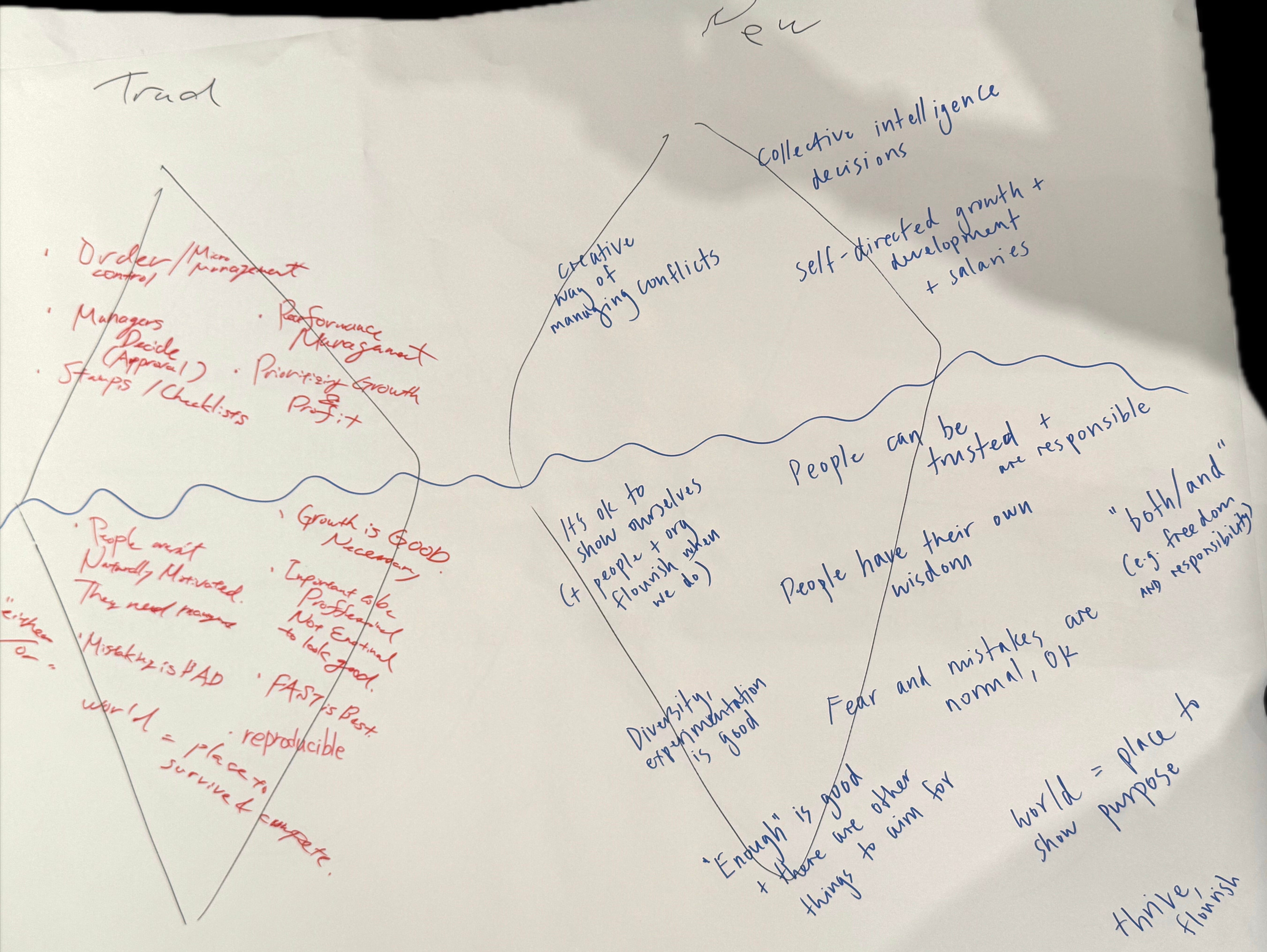
I was happy to hear Kenshu say that many people make the mistake of focusing only on implementing teal or self-managed structures. A useful exercise to do first, he said, is to look at the fundamental assumptions of ‘traditional’ organisations versus the fundamental assumptions of new paradigm organisations – in other words, below the surface of the iceberg. For example, in a traditional paradigm, an underlying assumption might be that people are not inherently motivated or responsible, therefore they need to be managed. In a new paradigm organisation, an underlying assumption might be that people are capable of managing themselves.
In Reinventing Organisations, we learn about FAVI where CEO Jean-François Zobrist who, together with his colleagues, made explicit the underlying assumptions about men and women in the factory that influenced the organisation design. For example, work tools were in a locked cupboard which needed a manager’s approval to be opened. Thus, they concluded that workers in the factory must therefore be thieves, lazy, not dependable, and not intelligent. Why else would they need to be controlled in this way? They defined three new assumptions – more inspiring ones – that would eventually became mantras in the factory: people are considered to be inherently good; there is no performance without happiness; and value is created on the shop floor. From these assumptions, totally different organisational practices could emerge.
The difference between green and teal
Kenshu also felt it was important to discuss the differences between Green-paradigm organisations and teal organisations, since we see a common pitfall of people getting stuck in the green stage. If you’re wondering if you might be stuck in green, here are three questions to help you reflect:
Are you comfortable with leadership in your organisation or is it a dirty word?
Are you able to transform conflicts or are you stuck in a prison of politeness and false harmony?
Are you able to allow people to contribute in different ways or are you attached to everyone being equal at all costs?
I’ve written a bit more about ‘The Green Trap’ in this post about hazards on the path to self-management but I wanted to share a metaphor that Kenshu articulated that really resonated with me. He learned this from George Por at the conference he went to in Rhodes in 2017.
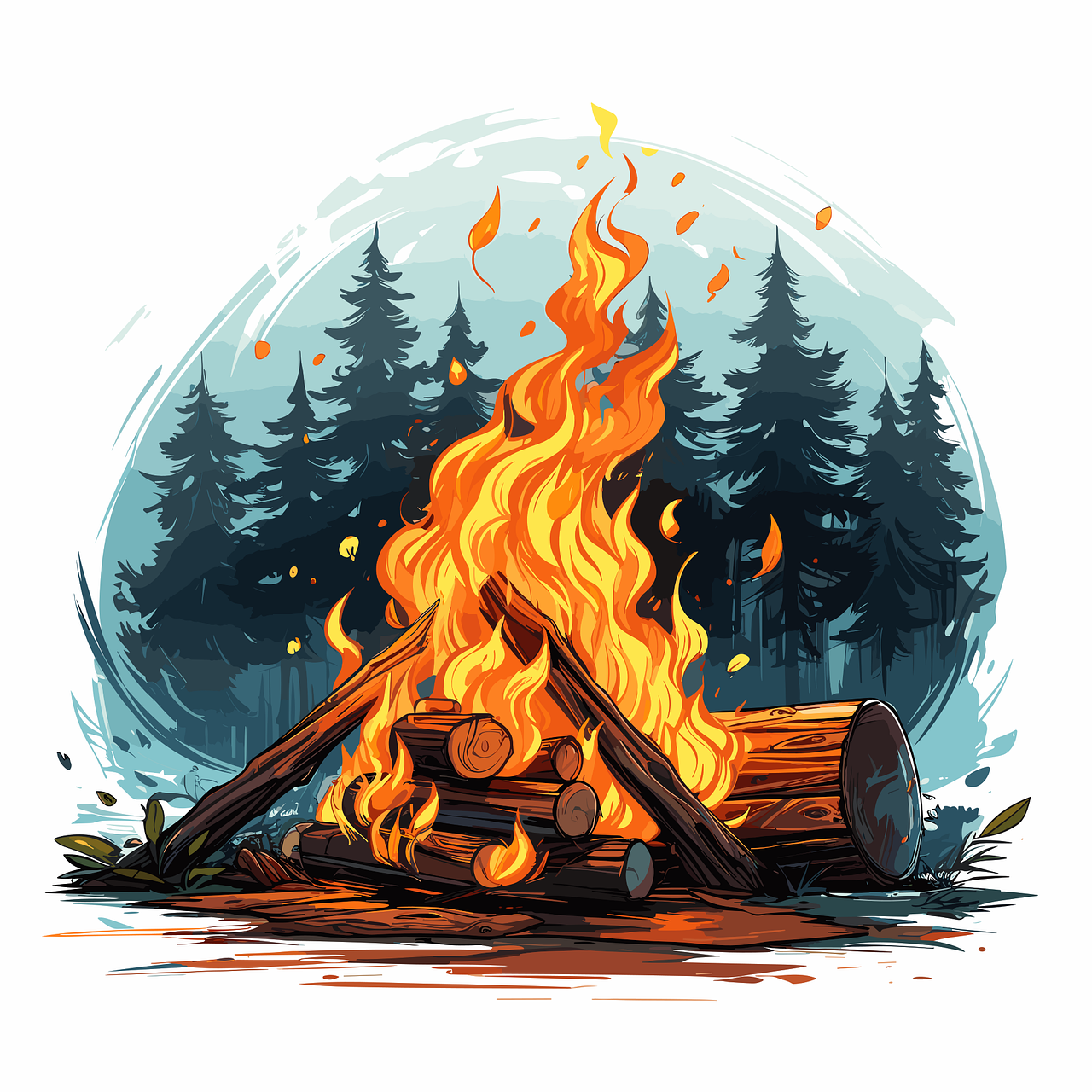
The green stage is light a campfire. We all like the sensation of sitting around the campfire – we’re close to each other, we feel the warmth and the bright glow of the flames. It feels safe, cosy.
But in the shadows, monsters are lurking that we do not see or dare confront. And there are also treasures in the shadows that we will never find if we stay in the comfort zone around the campfire. And if we sense any difference around the campfire, we eject it.
One of the participants in our workshop, Sam, observed that in a green organisation, we are following the culture or in the culture, whereas in a teal organisation, we are holding it, co-producing it. And Kenshu shared the metaphor that Frederic often uses of a forest; if you’re a mushroom, your goal is not to be as big as the tallest tree. But the forest wants you to be the best and biggest version of a mushroom you can be; and it wants the tall tree to be the best and biggest version of a tree it can be. Crucially, the forest needs both. An ecosystem wouldn’t function if the forest was trying to make every organism equal in size.
(Interestingly, the day after our workshop finished, our mutual friend Tom Nixon published this post about how Green and Orange might represent the same level of development but as a polarity – two opposing expressions of a deep desire for fairness and justice.)
Adult-adult leadership and culture
When it came to my turn to facilitate a session, I was nervous. I wasn’t sure if Tuff’s adult-adult approach would resonate in a Japanese context and I was cautious not to try and impose it but rather offer it with an open stance. What’s more, Yuji and I had never attempted to live-translate a demo with two people practising and me interrupting to give feedback or coaching. But Japan, I’m learning, is a high-trust, relational culture and so the group was willing to let us experiment!
We were thrilled to discover that not only did it work, it was actually very powerful. I had Yuji interpreting the words, but also, without the distraction of language, I could focus much more intently on people’s way of being. The group marvelled at how easily I could spot when someone was becoming overly responsible or ‘parental’ in their way of being, even without understanding what they were saying! Which just goes to show that how we are speaks much louder than what we say or do…
With each person who practised a coaching conversation, we identified the unhelpful mindset that was getting in the way for them to be adult-adult. “I need to solve this,” or “I need to take care of them.” There was lots of laughter and joy in discovering each other’s pitfalls. I also found it curious that the participants were much more able to receive my feedback and sit without answers than I’m used to in Europe. Hideaki told me this is probably because in Japanese culture, people are very comfortable with ambiguity.
I also shared with Hideaki that I noticed participants were also much more comfortable with silence and pauses than is typical in the West. In my experience, Western leaders tend to be quite impatient and solutions-driven and so if I ever ask them to slow down, or allow silence, they visibly squirm! He asked me why they’re so afraid of silence. “I don’t know,” I replied, “perhaps because being with silence means being with the unknown, the unpredictable? Maybe it’s about holding onto a semblance of control?”
Thoughts about the state of the movement
Kenshu and I have been working in this field for a decade, and it’s now eleven years since Frederic’s book was published. People often ask us: what is the current status of the movement? Was teal just a fad? Last July, in conversation with Pim de Morree, we talked about the good and the bad news. The bad news? These kinds of organisations are still very niche, and it seems when we look at the mainstream world of work, many leaders and organisations are going backwards – more hierarchy, more command-and-control. But the good news is, there are so many more organisations working in this way compared to when Frederic was researching his book. Corporate Rebels has mapped close to 1,000 of them. And communities spanning multiple countries are growing – sharing their challenges and learning. This gives me hope.
But let me close with Kenshu’s words, an extract from his afterword of the latest edition of the illustrated version of Reinventing Organisations (called Teal Organisations in Japanese):
I often compare organisational diversity to diversity in ways of living. Over human history, we have reduced war and inequality and, through advances in information and technology, reached an era where diverse ways of life are possible. No single life can be declared the correct one for all humanity. Each person shapes their own life according to their values and individuality.
I see teal organisations in the same way. There is not one “teal way.” Rather, we have finally gained the conditions to create organisations that value people while generating positive impact, each suited to its own context.
Teal is not a finished model but an entry point into new experiments. Experiments inspired by teal can encourage others, creating a chain that enriches the world with greater color and diversity. I hope such a chain will continue to spread.
And finally, to return to the opening question:
Have teal organisations ended?
I do not think so. Rather than ending, they are only just beginning.
Toward a society where each person can feel, “I am glad to have been born in this era.”
Toward a future where we can pass on a beautiful Earth and rich culture to the next generation.
I sincerely hope that ever more unique and vibrant organisations will emerge.December 2025
Kenshu Kamura
Yeah!
A lot of points of resonance here for me - perhaps in particular the principles underpinning JINEN - Embrace things as they are; Think from the now, not from the future; Adapt to the ever-changing nature of things. I have been thinking a lot about acceptance as a basis for growth in life - important to me as at my stage of life I have a lot less time left to enjoy than has past behind me. Through my research, reading and songwriting the idea of the road less travelled and the road travelled keeps recurring - with the underlying thought being, I am on the road I am on, not another, and the next steps are mine to choose - accepting where I am frees up the opportunities for that next step. Acceptance is not about giving in - it is about opening up possibilities. JINEN seems to me to be a good philosophy for life. Thanks for this article - so much more in it than I have referred to here. Mike